Threat Intelligence
Over 30,000 new CVEs are published every year — but fewer than 5% are ever exploited. turingsecure aggregates vulnerability data from NVD, CISA KEV, and EPSS to separate noise from real threats, so your team focuses on what actually matters.
What Is Threat Intelligence?
Global Threat Data, Contextualized for Your Organization
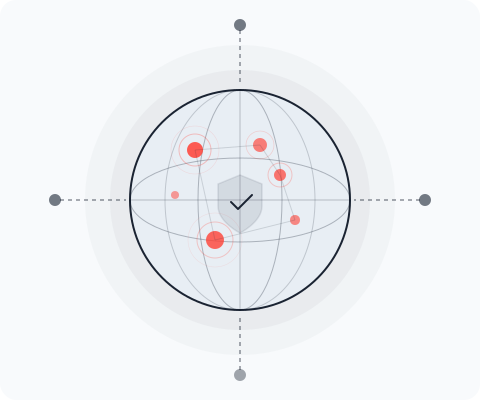
Threat intelligence answers a fundamental question: which vulnerabilities actually threaten my organization? Unlike attack surface management, which scans your own infrastructure from the outside, threat intelligence monitors the global threat landscape — every CVE, every exploit prediction, every actively exploited vulnerability.
CVSS scores alone are not enough. A Critical-rated vulnerability that has no public exploit and no active exploitation is far less urgent than a Medium-rated one that attackers are weaponizing right now. turingsecure adds the missing context: exploit probability, active exploitation status, and threat actor intelligence.
Intelligence Workflow
How Does Threat Intelligence Work in Practice?
CVE & KEV Tracking
The Foundation: Vulnerability Data You Can Act On
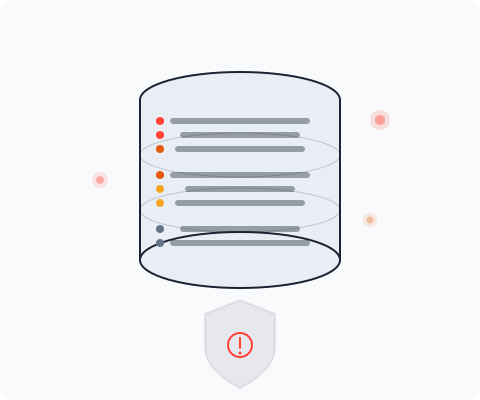
Every threat intelligence workflow starts with reliable vulnerability data. turingsecure maintains a continuously updated CVE database enriched with NVD details, CVSS vectors, affected products, and CWE classifications. On top of that, the CISA Known Exploited Vulnerabilities catalog identifies which of those vulnerabilities are confirmed to be actively used in real-world attacks.
- CISA KEV Catalog
Track over 1,100 confirmed exploited vulnerabilities with remediation deadlines. Filter by vendor, product, and date added.
- Severity & Vendor Filters
Narrow down thousands of CVEs by CVSS severity, affected vendor, publication year, or keyword. Find what is relevant to your technology stack.
- Active Exploitation Indicators
Instantly identify CVEs that are being exploited in the wild. Separate theoretical risk from confirmed, active threats.


EPSS & Prioritization
Risk-Based Prioritization: Focus on the Dangerous 2–5%
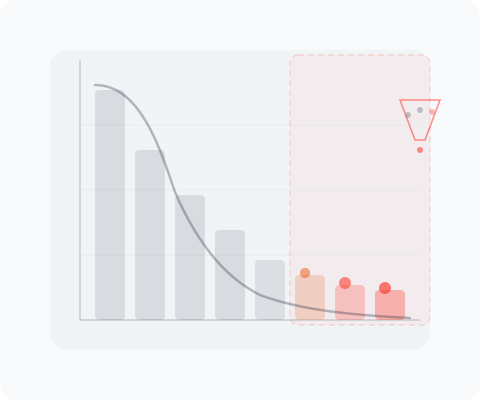
The Exploit Prediction Scoring System (EPSS) calculates the probability that a vulnerability will be exploited within the next 30 days. Combined with percentile ranking, EPSS transforms raw vulnerability counts into actionable priority lists.
Organizations using EPSS-based prioritization remediate critical threats faster while reducing alert fatigue by up to 80%. Instead of chasing every Critical CVSS score, your team focuses on the vulnerabilities that attackers are actually targeting.
- 30-Day Exploit Probability
Each CVE receives a probability score from 0 to 1, updated daily. A score of 0.9 means a 90% chance of exploitation within 30 days.
- Percentile Ranking
Understand where a vulnerability stands relative to all known CVEs. The 95th percentile means it is more likely to be exploited than 95% of all vulnerabilities.
- EPSS vs. CVSS
CVSS measures theoretical severity. EPSS measures real-world likelihood. Together, they provide the complete risk picture for informed prioritization.


See turingsecure in Action
Discover in a personal demo how turingsecure supports your security program.
Intelligence Lifecycle
From Collection to Action in Five Steps
Threat intelligence is not a dashboard — it is a process. turingsecure supports the entire intelligence lifecycle.
1. Collect
Automatically ingest vulnerability data from the National Vulnerability Database (NVD), CISA Known Exploited Vulnerabilities catalog, EPSS feeds, and darknet intelligence sources.
2. Enrich
Each CVE is enriched with CVSS v3.1/v4.0 vectors, CWE weakness classifications, affected products (CPE), exploit availability indicators, and KEV status.
3. Prioritize
Apply EPSS exploit probability scores to rank vulnerabilities by actual exploitation likelihood. Filter out the 95% of CVEs that will never be exploited.
4. Correlate
Map high-priority vulnerabilities against your asset inventory from attack surface management. Identify which of your systems are actually affected by trending threats.
5. Act
Generate patch priority lists based on combined threat intelligence. Track remediation progress through vulnerability management and measure time-to-remediate.
Core Features
Identify, Prioritize, Act
Structured threat intelligence across the entire vulnerability lifecycle.
CVE Database & KEV Tracking
Access the full CISA Known Exploited Vulnerabilities catalog enriched with NVD data. Filter by severity, vendor, and year. See which vulnerabilities are actively exploited and require immediate remediation.
EPSS Exploit Prediction
Risk-based vulnerability prioritization using the Exploit Prediction Scoring System. See the probability of exploitation in the next 30 days and focus remediation on the highest-risk vulnerabilities first.
Threat Landscape Analytics
Interactive dashboard with severity distribution, EPSS distribution, monthly vulnerability trends, and trending vulnerabilities. Understand the evolving threat landscape at a glance and report on it to stakeholders.
Platform Integration
Intelligence That Connects Across Your Security Stack
- CVSS v3.1 & v4.0 Calculator
Built-in calculators for both CVSS versions. Calculate scores interactively, share vector strings, and link directly from CVE records to the calculator for consistent severity assessments.
 Darknet Intelligence Correlation
Correlate threat intelligence with darknet monitoring findings. When compromised credentials or leaked data surface, connect them to known vulnerabilities and affected assets.
 IoC Tracking
Track Indicators of Compromise across incidents: IP addresses, domains, URLs, file hashes, and CVE references. Cross-reference indicators to identify patterns and recurring threats.
 Export CSV & JSON
Export threat intelligence data for SIEM integration and compliance reporting. Feed vulnerability and threat data into your existing security tools and automated workflows.
Related Modules
Threat Intelligence Powers Your Entire Security Program
Threat intelligence provides the context that makes every other security module more effective.
- Attack Surface Management
TI prioritizes your ASM findings. When a CVE affecting one of your exposed services is actively exploited, you know to remediate it first.
- Vulnerability Management
Feed EPSS scores and KEV status directly into your vulnerability tracking. Replace CVSS-only prioritization with real-world threat context.
- Darknet Monitoring
Correlate darknet findings with threat intelligence data. When stolen credentials appear, TI helps assess which vulnerabilities the attacker likely exploited.
- Incident Response
During an incident, TI provides rapid context: Is this CVE being actively exploited? Are there IoCs linked to known campaigns? What is the EPSS score?


Compliance
NIS-2 and DORA Require Threat-Based Risk Assessment
NIS-2 mandates that significant incidents must be reported to authorities within 24 hours — making rapid threat assessment a legal requirement, not just best practice. Organizations need documented evidence that they systematically monitor threats and prioritize remediation based on real-world risk.
DORA (Digital Operational Resilience Act) goes further for financial institutions, explicitly requiring threat intelligence-based risk analysis. turingsecure provides the documented threat monitoring, prioritization evidence, and exportable audit trails that both regulations demand.
- 24h Incident Reporting
Rapid threat context for NIS-2 incident classification. Assess severity within minutes, not hours.
- Audit-Ready Documentation
Exportable threat analysis history. Demonstrate to auditors that your organization monitors and acts on threat intelligence systematically.



Stay Ahead of Emerging Threats
See how turingsecure helps you prioritize vulnerabilities and respond to threats faster — with intelligence that turns data into decisions.